
Leased Line vs Broadband: What’s the Difference and Which Does Your Business Need?
June 30, 2026Choosing a broadband plan sounds simple until you start comparing speeds. Is 50 Mbps enough for your family? Do you really need 100 Mbps? And is paying for 200 Mbps or more worth it?
The answer depends on how you use the internet at home.
From office meetings and online classes to streaming movies, gaming, and everyday browsing, every household has different internet requirements. A working professional attending video calls needs a different setup from a family streaming entertainment across multiple smart TVs.
If you're looking for a broadband connection in Nashik, understanding your actual speed requirements can help you choose a plan that suits your lifestyle without paying for bandwidth you may never use.
In this guide, we'll explain the ideal internet speed for home use, compare popular broadband speeds, and help you select the right plan for your household.
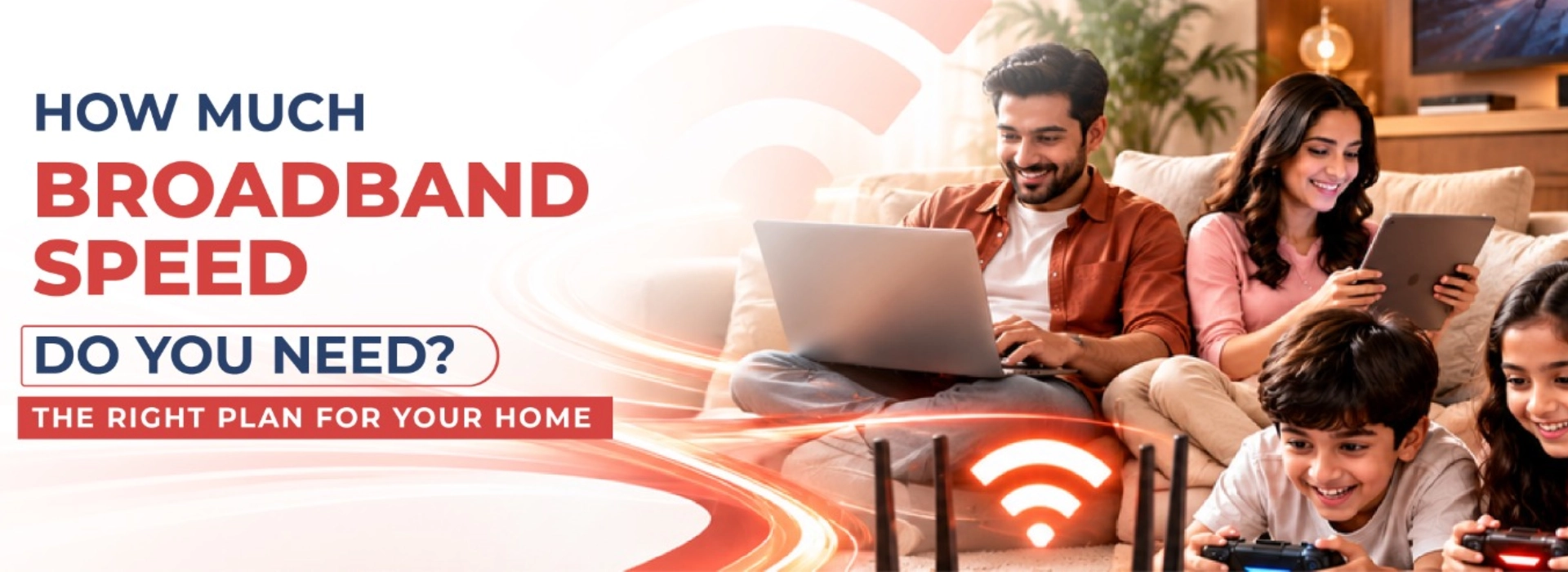
How Much Internet Speed Do You Need at Home?
For most households, a stable 100 Mbps broadband connection provides enough bandwidth for everyday activities, including video calls, HD streaming, online learning, and browsing.
However, the ideal speed depends on how many people use the internet simultaneously and what they do online.
Here's a practical guide.
|
Household activity |
Approximate download speed needed |
Suggested household broadband speed |
|
Browsing, email and social media |
1 to 5 Mbps per device |
30 to 50 Mbps |
|
HD video streaming |
5 to 10 Mbps per stream |
50 to 100 Mbps |
|
Full HD video calls |
3 to 8 Mbps per call |
50 to 100 Mbps |
|
4K video streaming |
15 to 25 Mbps per stream |
100 Mbps |
|
Online gaming |
Often 3 to 10 Mbps during gameplay |
100 Mbps |
|
Multiple users streaming and working |
Varies with simultaneous usage |
100 to 200 Mbps |
|
Large households with heavy usage |
Depends on connected devices |
200 to 300 Mbps or higher |
These are general planning estimates. Actual requirements depend on applications, devices, upload speeds, and network conditions.
Quick answer: A 100 Mbps plan is a practical starting point for many Nashik households. Families with multiple heavy internet users may benefit from 200 Mbps or higher, while individuals with limited usage may need less.
Understanding Mbps: What Does Broadband Speed Actually Mean?
Before choosing a broadband plan in Nashik it's important to understand what internet speed means.
Broadband speed is generally measured in megabits per second, or Mbps. It indicates how much data your connection can transfer each second.
Higher Mbps allows more data to move through your connection, which is especially useful when multiple devices are active simultaneously.
However, broadband performance depends on more than one number.
Download speed
Download speed determines how quickly your device receives data from the internet.
It affects activities such as watching videos, loading websites, downloading applications, and streaming entertainment.
Upload speed
Upload speed determines how quickly your device sends data to the internet.
It is important for video calls, uploading large files, cloud backups, and sharing presentations.
For anyone seeking a broadband connection for work from home, upload performance deserves as much attention as download speed.
Latency
Latency measures how long data takes to travel between your device and server.
Lower latency can improve responsiveness during online gaming, video calls, and other real-time activities.
A higher-speed broadband plan does not automatically guarantee lower latency.
Connection stability
A stable connection maintains consistent performance throughout the day.
For everyday users, reliable 100 Mbps broadband may provide a better experience than a faster connection that frequently slows down or disconnects.
Is 50 Mbps Enough for Home Internet?
Yes. A stable 50 Mbps connection can be sufficient for individuals and smaller households with moderate internet requirements.
It can support everyday activities such as browsing websites, checking emails, attending video meetings, and streaming HD entertainment.
For example, a person living alone who works online during the day and watches videos in the evening may find 50 Mbps adequate.
However, performance can become less comfortable when several devices are active simultaneously.
A laptop downloading updates, a television streaming video and multiple smartphones using the internet can compete for the available bandwidth.
For households with growing internet requirements, 100 Mbps offers additional flexibility.
The key is to consider your household's actual usage rather than assuming that a faster plan is always necessary.
Is 100 Mbps the Best Internet Speed for Home Use?
For many families, 100 Mbps is an excellent balance between speed, convenience, and everyday connectivity.
It offers enough bandwidth for common household activities without requiring an unnecessarily high-speed connection.
What can you do with 100 Mbps broadband?
A stable 100 Mbps connection can generally support:
- HD and Full HD streaming on smart TVs.
- Online classes and educational videos.
- Video meetings and work-from-home activities.
- Social media, browsing, and online shopping.
- Online gaming on compatible devices.
- Multiple smartphones and laptops connected simultaneously.
Consider a family of four.
One person is attending a video meeting, another is watching an online lecture, someone is streaming a movie, and another family member is browsing social media.
A reliable 100 Mbps connection should generally provide sufficient bandwidth for these activities.
This makes 100 Mbps a practical option for working professionals, couples, and small to medium-sized families in Nashik.
However, your actual experience will depend on Wi-Fi coverage, device capabilities, and the speeds delivered to each device.
When Should You Choose a 200 Mbps Broadband Plan?
A 200 Mbps connection offers more bandwidth for households where several people use the internet heavily at the same time.
You may not need 200 Mbps for everyday browsing or a single video call. However, the additional capacity becomes useful when multiple demanding activities happen together.
A 200 Mbps plan may be suitable if:
- Several family members work or study online.
- Multiple smart TVs stream HD or 4K entertainment.
- Large files are frequently downloaded or uploaded.
- Online gaming happens alongside streaming.
- Multiple devices run cloud backups and software updates.
- Your household expects increased internet usage.
Imagine a family where two people work remotely; one child attends online classes and another streams 4K entertainment.
A 200 Mbps plan can provide more capacity for these activities without immediately exhausting available bandwidth.
For larger households or families with demanding connectivity needs, 200 Mbps may be worth considering.
However, upgrading your plan will not automatically solve problems caused by weak Wi-Fi signals or outdated routers.
What Broadband Speed Is Best for Working from Home?
Working from home requires more than fast downloads. A reliable connection should support video meetings, file sharing, cloud applications, and communication tools without frequent interruptions.
If you're choosing a broadband connection for work from home, pay attention to download speed, upload speed, and connection stability.
For basic remote work
If your work mainly involves emails, browsing, documents, and occasional video calls, a stable 50 Mbps connection can be sufficient for one person.
For regular video meetings
Professionals attending frequent meetings on Zoom, Microsoft Teams or Google Meet should consider a 50 to 100 Mbps household plan, particularly if other people use the connection simultaneously.
Video calls typically need far less than 50 Mbps individually. The additional capacity helps when other activities share the connection.
For heavy remote work
If your work involves uploading large design files, sharing video content, accessing cloud systems, or transferring substantial amounts of data, 100 to 200 Mbps or higher can be useful.
Upload speed becomes especially important for these activities.
For example, uploading a 1 GB file over a connection delivering 10 Mbps upload speed takes roughly 13 minutes under ideal conditions. At 100 Mbps, the theoretical transfer time is around 80 seconds.
Actual transfer times depend on network overhead, server limits, and connection stability.
Practical recommendation: For households with one or two remote workers and other connected devices, 100 Mbps is a sensible starting point. Consider 200 Mbps when several people regularly perform bandwidth-intensive activities together.
How Much Speed Do You Need for Streaming, Gaming and Online Classes?
Different online activities have different bandwidth requirements.
Watching movies and OTT entertainment
A single Full HD video stream typically needs far less than 100 Mbps. For example, Netflix recommends at least 5 Mbps for 1080p and 15 Mbps for 4K playback. Netflix's internet speed recommendations provide a useful benchmark.
However, if multiple family members stream simultaneously, their bandwidth requirements add up.
Playing online games
Online gaming depends heavily on latency, packet loss, and connection stability.
Many multiplayer games use relatively little bandwidth during gameplay, but downloading games and updates can require substantial data.
A 100 Mbps plan is suitable for many gaming households, while faster plans can reduce large download times when the game server supports them.
Attending online classes
Most online classes involve video, audio, presentations, and occasional file downloads.
A stable 30 to 50 Mbps connection may be sufficient for a student, but households with multiple students and working adults may benefit from 100 Mbps or more.
Using smart home devices
Smart speakers, security cameras, televisions, and connected appliances also share your home network.
While many smart devices use limited bandwidth, cameras uploading continuous video can increase upload requirements.
When selecting internet speed for home use, consider the entire household rather than focusing on one activity.
How Many Devices Can a 100 Mbps Broadband Connection Support?
There is no fixed number of devices that a 100 Mbps connection can support.
Ten smartphones connected to Wi-Fi, but sitting idle may use very little bandwidth. Three televisions streaming 4K videos can consume significantly more.
What matters is how many devices are actively transferring data at the same time.
Consider this example:
|
Simultaneous activity |
Estimated bandwidth |
|
One Full HD video stream |
8 Mbps |
|
One 4K video stream |
20 Mbps |
|
One video meeting |
5 Mbps |
|
Browsing and other activities |
10 Mbps |
|
Total estimated usage |
43 Mbps |
These figures are illustrative, not guaranteed requirements.
A stable 100 Mbps connection should have adequate capacity for this example, with additional bandwidth available for fluctuations.
However, large downloads, cloud backups, and other heavy activities can increase demand.
This is why the number of active users matters more than the number of devices connected to your router.
Choosing the Right Broadband Plan in Nashik
If you're comparing a broadband plan in Nashik, start with your household's actual requirements.
A small household with basic browsing needs may not require the same speed as a family with several remote workers, students, and smart TVs.
Use this comparison as a starting point.
|
Household type |
Suggested broadband speed |
Main requirements |
|
Individual with basic internet usage |
30 to 50 Mbps |
Browsing, email, occasional streaming |
|
Working professional or couple |
50 to 100 Mbps |
Video meetings, streaming, browsing |
|
Family of three to four |
100 Mbps |
Multiple devices, HD entertainment, online classes |
|
Family with heavy simultaneous usage |
200 Mbps |
Remote work, gaming, multiple streams |
|
Large household with demanding usage |
300 Mbps or higher |
Multiple heavy users and large downloads |
The best plan is the one that comfortably supports your busiest hours without requiring you to pay for unnecessary capacity.
Should You Choose a Monthly or Annual Broadband Plan?
Broadband providers may offer monthly, quarterly, half-yearly, or annual payment options.
A monthly plan can provide flexibility when you're testing a new provider or expect to relocate.
Longer-duration plans may offer better overall value, but only when the provider offers a genuine price advantage.
Before committing, compare the total amount payable, taxes, installation charges, equipment conditions and refund policy.
For example, Vortex's published terms state that its prepaid plans are non-refundable for unused periods following early cancellation.
Vortex Infocom Internet services
The specific plan prices and terms applicable to Nashik should be confirmed before subscribing.
What Should Nashik Households Check Before Getting a Broadband Connection?
Choosing a broadband connection in Nashik involves more than comparing advertised speeds.
Internet service availability can differ between neighbourhoods, residential societies, and individual buildings. Even within the same locality, installation feasibility may vary.
Before selecting a provider, check out these six factors.
- 1. Fiber availability: Confirm whether fiber broadband infrastructure reaches your building or home.
- Actual download and upload speeds: Compare both, particularly if you work remotely or frequently upload files.
- Wi-Fi coverage: A larger apartment or multi-storey house may require additional access points or a mesh Wi-Fi system.
- Plan validity and charges: Understand monthly costs, GST, installation fees, router conditions and renewal requirements.
- Customer support: Check how to report connectivity problems and request technical assistance.
- Connection reliability: Look for consistent performance during busy evening hours when several household members may be online.
Whether you live in Gangapur Road, College Road, Indira Nagar, Panchavati or another part of Nashik, confirm service availability for your exact address rather than assuming citywide coverage.
Why Consider Vortex Fiber for Your Home Internet Needs?
From streaming your favourite shows to working online and gaming, Vortex Fiber offers residential broadband plans for your household’s everyday internet needs.
Choose from speed options of 100 Mbps, 200 Mbps, 300 Mbps, and 400 Mbps, with flexible payment durations. With fiber connectivity and customer support, Vortex helps you stay connected to work, entertainment and everything in between.
To find the right plan for your home and get details on installation, visit Vortex Infocom or call 8873 121 121.
Frequently Asked Questions
1. How much internet speed is enough for a family of four?
A stable 100 Mbps connection is generally sufficient for a family of four using the internet for HD streaming, online classes, browsing and video meetings. Consider 200 Mbps if several members regularly perform bandwidth-intensive activities simultaneously.
2. Is 50 Mbps enough for working from home?
Yes. A stable 50 Mbps connection can support email, cloud applications and video meetings for one remote worker. Upload speed, latency, and connection reliability also matter.
3. Is 100 Mbps better than 50 Mbps for home use?
100 Mbps provides twice the theoretical download bandwidth of 50 Mbps. It is particularly useful when multiple devices are active, although individual browsing or video calls may feel similar on both connections.
4. Do I need 200 Mbps for Netflix and OTT streaming?
Not necessarily. A single HD or 4K stream generally requires much less than 200 Mbps. Higher-speed plans become useful when multiple people stream or download content simultaneously.
5. What is the best broadband plan in Nashik for work from home?
A 100 Mbps plan by vortex infocom is a practical starting point for many remote-working households. Compare upload speeds, connection stability, customer support and address-level availability before choosing a provider.
6. Does higher Mbps mean better Wi-Fi coverage?
No. Mbps measures connection bandwidth, while Wi-Fi coverage depends on router placement, wireless technology, interference and building layout. A faster broadband plan cannot automatically eliminate weak Wi-Fi signals.
7. How do I choose a broadband connection in Nashik?
Compare speed requirements, monthly costs, download and upload performance, fiber availability, installation conditions and customer support. Confirm that the provider serves your specific address.
Conclusion: Choose the Speed Your Home Actually Needs
The right broadband speed is not necessarily the fastest available. It is the speed that comfortably supports your household's everyday activities.
For individuals with basic requirements, 30 to 50 Mbps may be sufficient. For families balancing work, learning and entertainment, 100 Mbps is a practical starting point. Households with multiple heavy internet users may benefit from 200 Mbps or higher.
When choosing a broadband connection in Nashik, focus on consistent performance, sufficient bandwidth, and reliable support rather than speed alone.
If you're exploring Vortex Fiber, check whether service is available at your address and compare the applicable plans before making a decision.
The right speed for your home. The right connection for everything you do.
Ready to find the right speed for your home? Contact Vortex Infocom to check availability at your address and get started.

Frequently Asked Questions
What is the difference between leased line and broadband?
Broadband is a shared internet service where bandwidth is distributed among multiple users. A leased line provides a dedicated internet connection exclusively for your business, offering guaranteed speeds, lower latency, and higher reliability.
Is a leased line better than broadband for business?
Yes, if your business depends heavily on uninterrupted internet, cloud applications, video conferencing, or hosting services. For smaller businesses with lighter internet usage, broadband remains a cost-effective option.
Do I need a leased line for my business?
If internet downtime directly impacts your operations, productivity, or customer experience, a leased line is worth considering. Otherwise, a reliable business broadband connection may be sufficient.
What is a dedicated leased line internet connection?
A dedicated leased line internet connection is a private internet circuit reserved solely for one business. Unlike broadband, bandwidth isn't shared with neighbouring users, ensuring consistent speeds and enterprise-level reliability.
The Bottom Line
The debate isn't simply leased line vs broadband.
It's about choosing the connection that matches the way your business works.
If your internet is simply a convenience, broadband is an excellent choice.
If your internet is the foundation of your business, a dedicated leased line delivers the consistency, reliability, and performance that growing organisations need.
At Vortex, we understand that every business is different. Whether you're looking for a dependable broadband connection for business or a high-performance business internet leased line, we'll help you find a solution that keeps your team connected and your business moving forward.
Because business doesn't wait for loading screens. Neither should your internet.
Ready to find the right connection for your business? Get in touch with us today and we'll help you get started.